
White County Court Record Requests
Find the office that keeps the file before anything else. The White County Circuit Court Clerk holds Circuit, Criminal, and General Sessions records. The minutes sit there too. White TnCIS offers a public index search. The clerk-linked docket site posts selected court lists. Want an official copy? Call 931-836-3205 or visit 111 Depot Street, Suite 1, Sparta, TN 38583. Hours run Monday through Friday, 8:00 a.m. to 5:00 p.m. The clerk posts no dedicated White County request form. Confirm mail instructions, payment, and delivery before you send anything.
Chancery files go to Clerk and Master Gena Brock. Her office is Room 303, 1 East Bockman Way, Sparta. The phone is 931-836-3787. Juvenile Court sits at 111 Depot Street. It lists 931-836-2069. Confidentiality rules govern those records. Sparta City Court keeps its own municipal files. Federal cases run through PACER and the federal clerk, never a county counter. To find a record you can inspect online, start with a White County docket search. Pull the exact case number from it.
- Name the court, case number, year, and public caption.
- Identify the document, date range, and whether inspection may suffice.
- Choose a plain, certified, exemplified, transcript, or recording copy.
- Ask the custodian for the fee estimate and accepted payment method.
- Confirm pickup, mail, or electronic delivery before authorizing work.
Match White County’s Custodian
"Court record" names no single office. Beverly Jolley's Circuit Court Clerk office handles Circuit, Criminal, and General Sessions records and the court functions around them. Chancery belongs to Gena Brock, the Clerk and Master. Juvenile records travel the Juvenile Court route. Municipal files stay with the Sparta City Clerk or City Court. A deed, recorded judgment, lien, or court order may also appear in land records with the Register of Deeds, but that recorded instrument is not the whole case file.
Location matters just as much. The county courthouse sits at 1 East Bockman Way, while Circuit and Criminal service runs from 111 Depot Street. Archives occupies Room 304 at the Bockman Way courthouse, next to yet separate from the Clerk and Master in Room 303. Name the court when you call. Walk in asking only for "the courthouse" and you may land at the wrong counter.
The county court-system page identifies the local offices and contact paths.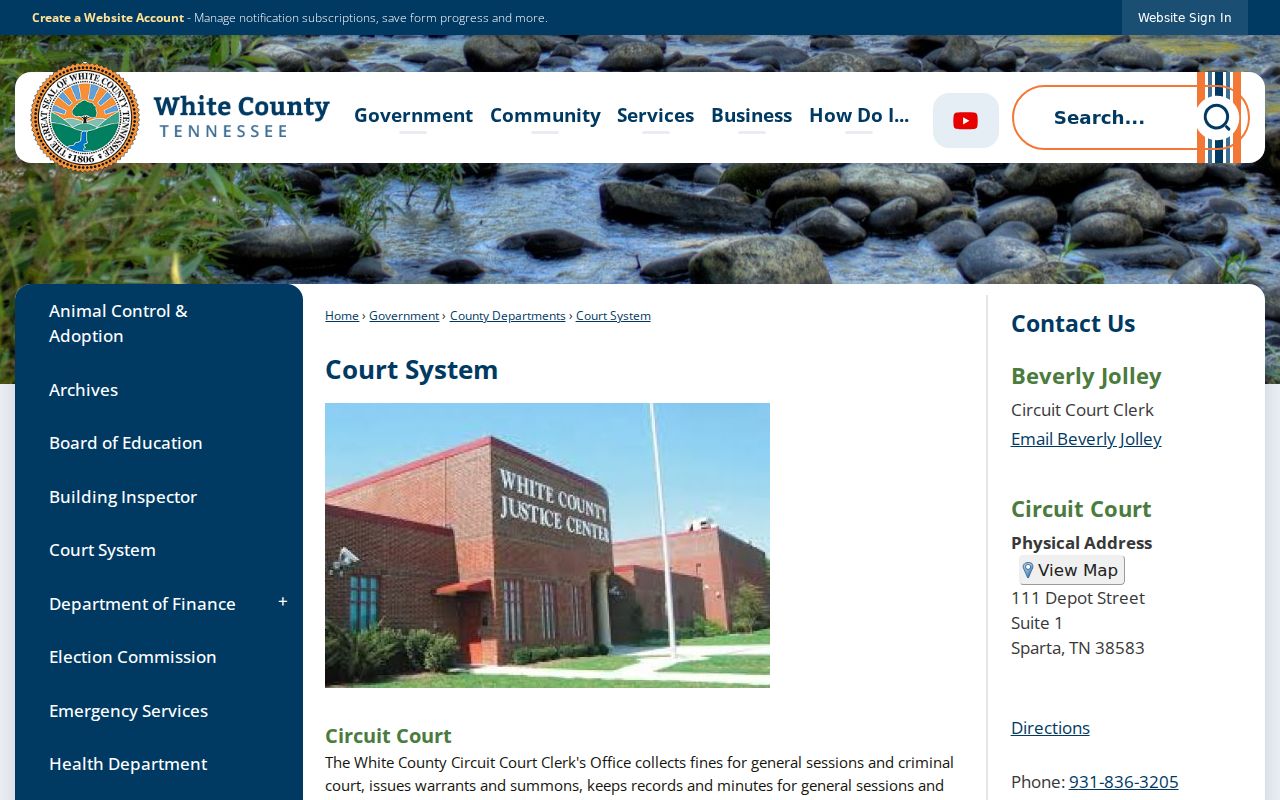
The official listing helps route a record to the office that actually keeps it.
Kinds of Court Records
A docket sheet is the timeline of a case. It is not the same as each document listed on it. A pleading puts a party's filed position or request on paper. An order records what a judge directed. A judgment states the outcome or relief. Exhibits can face custody, size, confidentiality, or return limits. A transcript comes through a reporter process, and an official electronic recording, when made and retained, is priced under Tennessee Rule 26 rather than ordinary page-copy rates.
The published White County dockets are calendar lists. A criminal list shows docket and prepared dates, the judge, page, case number, linked references, hearing type, time, charge details, attorney, bond, and status notes. Those fields help you find a case. What they do not do is expose every filed item or a document image. So when you need an order, judgment, or charging instrument, ask for that item by name instead of requesting "the docket."
| Requested item | What it answers | Likely route |
|---|---|---|
| Docket sheet | Chronology of entries and settings | Case index or clerk |
| Pleading or charge | What was filed or alleged | Public case file |
| Order or judgment | Court ruling or disposition | Clerk-certified file |
| Transcript | Written proceeding record | Reporter process |
| Recording | Official audio if made | Court under Rule 26 |
Three White County Record Layers
Three layers stand between you and the paper. White TnCIS comes first, a public case index covering visible Circuit Court and General Sessions civil and criminal selections. Its own terms say it is not an official court record and may change. Second is the clerk-linked published docket, sorted into General Sessions Civil, General Sessions Criminal, Circuit Civil, Circuit Criminal, and Child Support. It carries a prepared-date warning and can lag behind. Third is the actual file held by the clerk, the only layer that can produce an official or certified copy.
Use each layer for its purpose. The index finds a reference. The published docket reviews a setting list. The clerk file holds the document itself. None of them substitutes for a live clerk confirmation when a court date or deadline is near, and a screen capture proves neither service, finality, nor authenticity.
The White County Online Court Records System shows the local inquiry layer.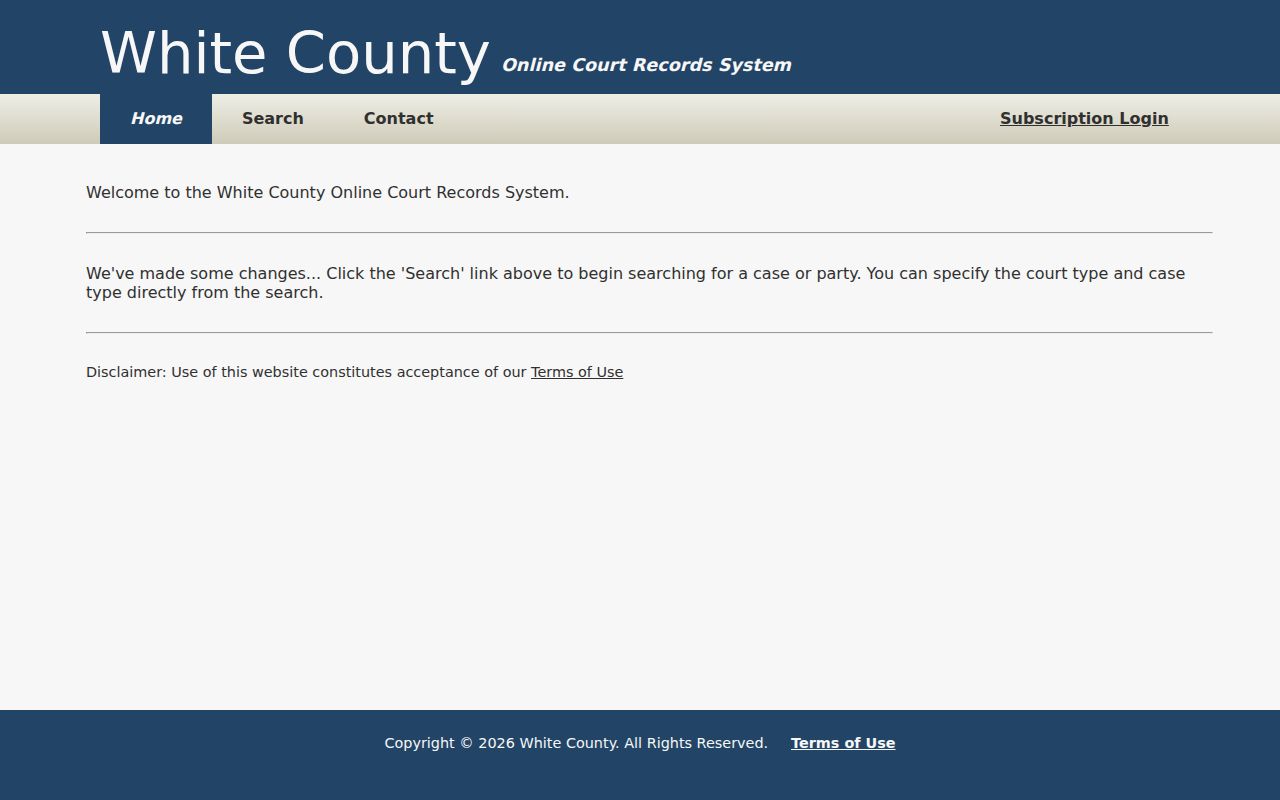
The portal is useful for identification, while certified records remain a clerk service.
Court Records: What They Contain
What sits in a file depends on the court. The case type and access status matter too. A public file can hold an index, pleadings, process papers, motions, orders, and disposition entries. Financial pages may show court costs or payments. A criminal file might contain a charging instrument and bond information. It may also hold hearing records, a plea, judgment, and sentencing entries. Civil records often run from complaint and answer through motions, orders, judgment, and execution material. Not every item is public, scanned, or kept in the same form.
| Case identity | Number, court, type, caption, and filed date |
|---|---|
| Docket sheet | Chronological events, filings, and settings |
| Pleadings | Filed claims, responses, and motions |
| Orders and judgment | Signed rulings and final disposition when entered |
| Exhibits | Filed or admitted material, subject to access limits |
| Transcript or audio | A separate proceeding record when available |
Give the clerk a date range. Ask for the document by its exact name. If a file mixes open and confidential pages, ask whether inspection or a redacted copy is available instead of assuming the whole file is closed.
Historic White County Court Files
A modern name search will not surface every old White County court record. For historical civil and criminal files, marriage and divorce material, and probate sources, turn to the White County Archives. The office sits in Room 304 at 1 East Bockman Way in Sparta. The phone is 931-837-4066. Microfilm at the Tennessee State Library and Archives holds White Circuit Court minutes from 1841 through 1899. Its county inventory lists later civil and criminal ranges as well.
When you write, give names and a rough year. Include the court, the record type, and any book, roll, or case reference. Spelling and indexing changed a lot over the decades. An empty TnCIS search has a narrow meaning. It only means the modern public index returned no row. The case may still sit in an archive. Genealogy and local-history work should keep source dates on hand. Skip republishing personal details from newer files.
The county Archives page shows the official historical research route.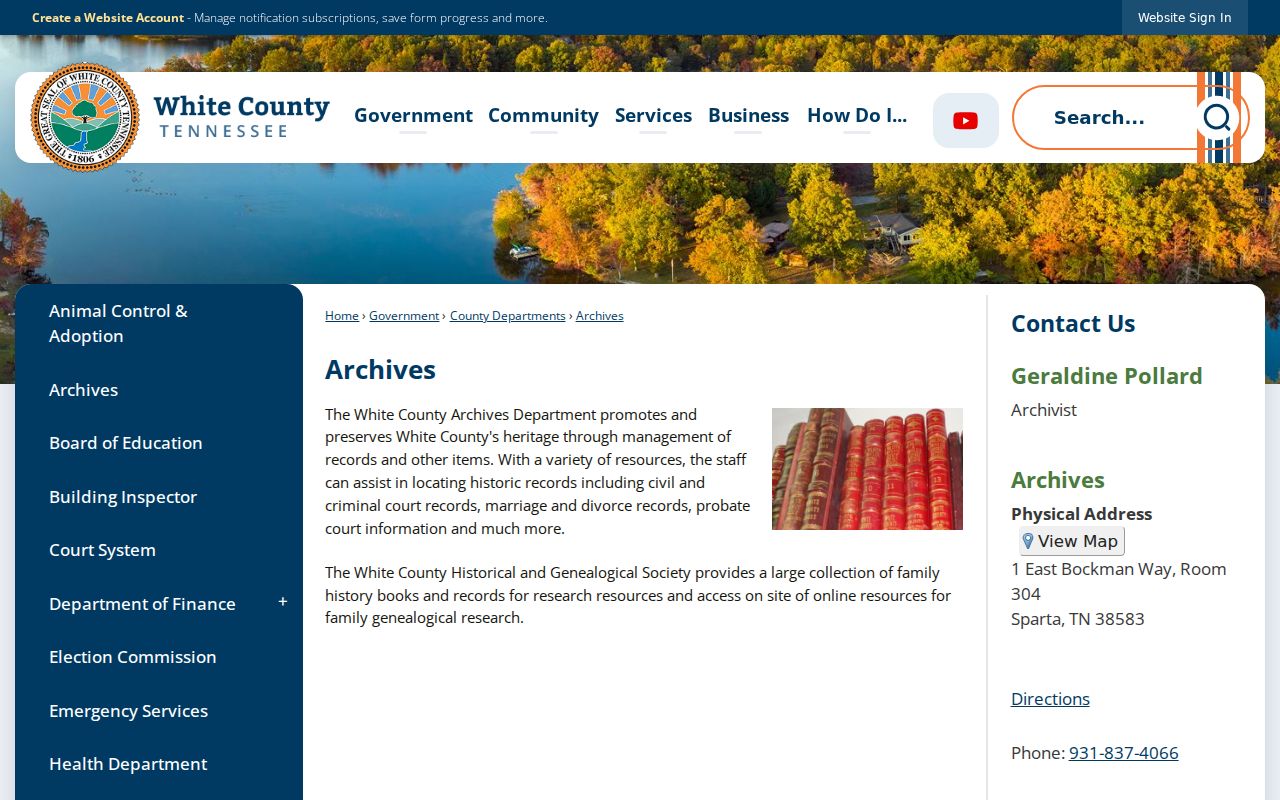
The archive route extends research beyond the current clerk portal.
Copy Fees and Certification
Know the difference before you order. A plain copy just reproduces the record. A certified copy carries the clerk's certification, which matters when you must prove authenticity. An exemplified copy goes through a further authentication process. White County does not post its certified, exemplified, docket-sheet, search, image, or staff-research fees, so call the clerk and ask. Say whether a plain copy would serve your purpose.
| Record or service | Published reference | White County caution |
|---|---|---|
| Plain copy | 50 cents per page in the cited AOC manual category | Confirm current local application |
| Certified copy | No White trial-court rate located | Ask for per-document total |
| Duplicate recording | $50 with original order; $100 later under Rule 26 | Confirm recording exists |
| Standard transcript | $4 per page AOC reporter reference | Reporter sets estimate and process |
| Additional transcript copy | 50 cents per page reference | Confirm with reporter |
The statewide references are not a White County fee sheet. Rule 26 does offer an indigent exception for the recording fees it describes. Ask the clerk for a written estimate. Ask about the accepted payment method. Never send cash. Do not assume Sparta's ticket payment system takes court-record orders.
White County Circuit Court Clerk
111 Depot Street, Suite 1
Sparta, TN 38583
931-836-3205
Record Requests Are Not Filings
Asking to inspect or copy a record files nothing. It is not a motion, answer, appeal, or expungement petition. White County's generic contact form is not a court-record request system. It is not an authorized filing channel. When a deadline is running, follow the process the court and clerk set out. Tennessee Rule 5B allows e-filing only through a locally authorized system for registered users. White County offers no public e-filing portal.
Tennessee's 2025 request for proposals covers a statewide case-management and e-filing solution. That signals change in state technology. It promises no White County launch date. Check with the Circuit Clerk or Clerk and Master. Ask about the filing method and local rule in force now. Keep your copy request apart from the legal task that made you need the record.
Access Rules for Court Records
The public can inspect court records unless another rule makes them confidential. Tennessee Supreme Court Rule 34 states that right. Its exceptions cover sealed or protected records, unpublished drafts, a judge's unfiled individual copy, deliberative material, certain recusal information, and records whose release would interfere with judicial functions. Handle juvenile and expunged matters with special care.
Public access has boundaries. Ask the custodian what public portion, redacted copy, or inspection method is available. A visible index entry does not make every document open.
The Tennessee Public Records Act expects a detailed request. It must identify the record. Citizenship and identification can affect statutory access. That applies in the situations set by T.C.A. §10-7-503(a)(4). White County publishes no public-record policy. There is no Public Records Request Coordinator page. So get current local procedure straight from the clerk who holds the record. Do not borrow the AOC's state-office policy for a county request.
Build a Precise White Request
Start with the basics. Write down the court. Add the exact case number and year. Then note the official caption and a date range for your search. Name the item itself too. That could be a docket sheet, judgment, order, charging instrument, transcript, exhibit, or complete public file. Say whether you want inspection, a plain copy, or a certified copy. An exemplified copy, a transcript, or audio counts too. Before authorizing copies, ask about redaction, format, delivery, the estimate, and payment.
These details help staff tell a Circuit file from a General Sessions reference. They can also tell a Chancery file from an archive source. And they separate a court judgment from a recorded instrument. The details cut delay when the public index runs thin. Confirm anything time-sensitive directly with the office holding the original.